A Borrowing Shelf Works Better with a Clear Return Place
A clear return place for a borrowing shelf helps neighbours put tools back where others can find them, without a booking app or tracking system.
A neighbour reaches for the hand drill on the borrowing shelf, but finds a tape measure, a loose screw and an empty patch of wood instead. The drill is somewhere in the building; nobody knows where. A clear return place for a borrowing shelf can prevent that small mystery by making the next action obvious, even when the tool’s borrower has gone home.
The idea is modest: agree on one visible place for returned items, make it easy to recognise, and show neighbours how to use it. This is not a stock-control system. It is a shared habit built around a shelf, cupboard or table that people already pass.
Choose the return spot
Start by looking at the route people take when they borrow something. A return place hidden behind a locked door or tucked at the end of a corridor is likely to be missed. The best spot is easy to reach, visible from the borrowing shelf and out of the way of doors, walkways and other shared activities.
For a small collection in a residents’ hall, that might be a shallow tray on the same shelving unit as the tools. In a community workshop, it could be a marked section of the bench beside the tool cupboard. Choose a place that suits how the collection is actually used, rather than adding furniture or signs that nobody needs.
Check that the location is sensible for the particular items. A damp entrance can be a poor home for cardboard labels or metal tools. A return tray must not obstruct an accessible route, fire equipment or the ordinary use of the room. If the spot could interfere with a building’s safety arrangements, ask the person responsible for the premises to advise.
Keep the return place near enough to the borrowing shelf that someone can understand the connection at a glance.
Agree what belongs there
Decide whether the spot is for every shared tool or only for items that do not have an obvious home. A single landing place for the whole collection is simple to explain. If tools need separate storage, the return place can act as a temporary stop before a neighbour puts each item back in its labelled place.
That distinction matters. A tray can become a permanent pile if nobody knows whether to leave items there or move them on. Keep the rule plain: for example, “Return borrowed tools here; put them away if their labelled place is clear.” Use whichever version fits the collection, and avoid two instructions that pull in opposite directions.
It also helps to agree what counts as returned. If a borrowed tool is clean, safe to handle and back in the shared area, it may be ready for the next person. If it needs attention, place it in a separate, clearly marked spot rather than mixing it with items ready to borrow. For safety-critical tools or equipment, follow the maker’s instructions and the site’s local rules; general shelf habits are not a substitute for either.
Make the place recognisable
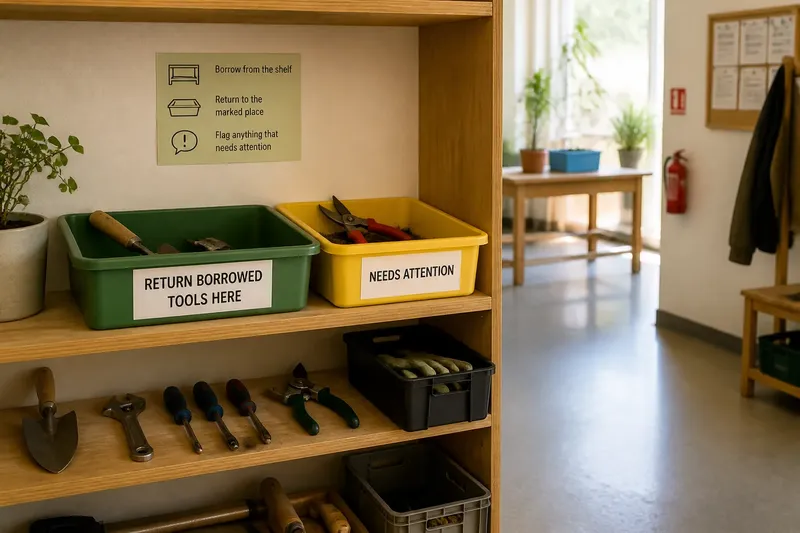
Give the return spot a clear visual cue. A sturdy tray in a distinctive colour, a simple “Returns” sign or a painted outline can work. The cue should be legible from the shelf and understandable without a long explanation. Keep wording large enough to read at a glance, and use a material that suits the room.
Make the cue specific to the action, not just the object. A label saying “Tools” may describe the whole shelf; “Return borrowed tools here” tells a neighbour what to do. If the collection includes bulky items that will not fit in a tray, show where they should stand without blocking the route.
Use a small number of clear categories only if the collection needs them. For instance, separate “Ready to borrow” from “Needs attention” when the difference is important. Too many compartments can make a simple return feel like paperwork, and a returning neighbour may choose a random space rather than work out a complicated system.
Say you share a shelf with a hand trowel, a small spanner and a pair of secateurs. Imagine a neighbour borrows the secateurs for a courtyard tidy, then returns them with plant residue still on the blades. If the agreed return spot has a separate “Needs attention” tray, the next borrower can see that the secateurs are not ready to use; the expected visible result is a clean shelf for usable tools and one clearly identified item awaiting attention.
Set a simple return routine
Agree on what the borrower should do before leaving the shared space. The routine need not include a sign-out sheet or a message thread. It can be as simple as returning the item to the agreed spot, placing anything incomplete in the attention area, and telling the group if something is missing or damaged.
Keep the routine within the borrower’s control. If a tool is too large for the return tray, provide a marked floor space or a shelf section. If the collection is in a room that closes at set times, explain the available return option rather than assuming someone will be there to receive it. The aim is a clear action that a neighbour can complete without tracking down a keyholder.
Where people share the room, a brief conversation can establish the norm: point out the shelf, show the return spot and explain what happens to items that need attention. A short note beside the collection can reinforce that introduction for people who arrive later. Keep any contact details or access arrangements in line with the group’s usual privacy practices.
Make the return action easy to remember: borrow from the shelf, return to the marked place, flag anything that needs attention.
Keep the spot usable
A return place only helps if there is room to use it. When trays fill up, tools disappear under one another and the visual cue stops doing its job. Someone who looks at the shelf should be able to tell which items are ready, which have come back and which need a second look.
Agree who will clear returns into their usual homes when that is part of the arrangement. This might be a shared task during a regular tidy, rather than an expectation placed on one neighbour. If the collection is small enough, a return spot that doubles as the tool’s normal home may remove that extra task altogether.
Notice what people actually do. If returning neighbours keep leaving a certain item beside the tray, it may be too large, awkward to carry or unclear where it belongs. Adjust the location or label to match the observed behaviour. A mark on a shelf can be more useful than another paragraph of instructions.
Do not let the return area become a dumping point for unrelated donations. If people also contribute tools, decide whether those go directly on the borrowing shelf or wait elsewhere for someone to check them. Keeping returns distinct from new contributions helps neighbours understand what is available now and what still needs a decision.
When should the spot change?
Should returns go back on the shelf straight away?
That depends on the collection’s routine. If everyone can identify the tool’s home and confirm that it is ready to borrow, direct shelving keeps the return area clear. If condition or completeness needs a quick check, a separate return place makes the change of status easier to see.
What if the shared room is locked?
Agree on a return option that does not rely on someone being present, such as a clearly identified accessible shelf inside the room during opening hours. Do not leave tools in a public passage or unsecured outdoor spot if that creates a safety or loss concern; ask the venue contact to help find a suitable arrangement.
How can newcomers learn the routine?
Use a visible sign and explain the return place when someone first borrows an item. A neighbour who can see both the tool shelf and the return cue is less likely to need a separate set of instructions.
What if people keep returning tools elsewhere?
Look for a practical reason before adding more rules: the return spot may be hard to reach, too small or poorly labelled. Move it, change the cue or provide a sensible place for awkward items, then tell regular borrowers what changed.
Review the arrangement
After the shelf has been in use for a while, ask a few neighbours whether the return place is obvious and whether it fits the tools. Keep the question concrete: “Where would you leave this hand saw after borrowing it?” A quick answer can reveal whether the visual cue works better than a general question about the system.
Make one adjustment at a time. Move the tray closer, replace a faded label or give a bulky item its own marked space. If the arrangement is already clear, leave it alone; a familiar, dependable spot is often more useful than frequent redesign.
Write the agreed location into any shared note about borrowing, especially if people use the room at different times. Keep it brief and update it when the spot changes. The main phrase, a clear return place for a borrowing shelf, describes a physical cue neighbours can recognise without learning a new tracking system.
Before adding any tool to the collection, ask whether it can be stored safely and returned to a place people can see. That small decision keeps the return arrangement practical as the shelf grows.