How Mending Skills Travelled Before Repair Cafés
How mending skills travelled through everyday tasks, shared work and practical demonstration—and how to make those exchanges clear and welcoming today.
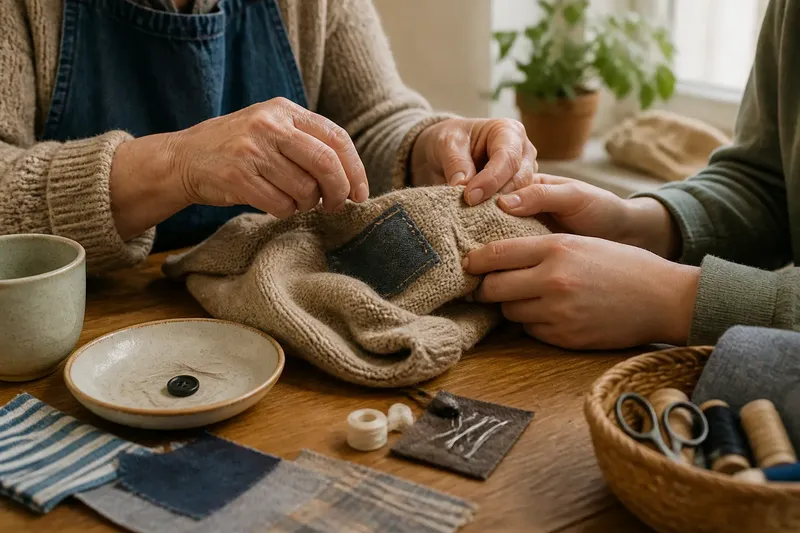
A loose button sits in a saucer beside the kettle, waiting for someone to pick up a needle. That small repair shows how mending skills travelled: through ordinary tasks, close observation and the chance to try a movement for yourself.
There is no need to claim one universal history. People learned in different households, trades and communities, shaped by local materials, work and circumstances. But the pattern is easy to recognise: a real object gave someone a reason to show what their hands knew.
Learning through tasks
At home, a learner might hold fabric steady, thread a needle or turn a hem while someone else worked. The task offered a practical reason to pay attention. It also gave the experienced person a moment to explain a choice: why a knot sits there, how a patch should lie or when a seam needs unpicking.
These exchanges did not always take the form of a planned lesson. A coat needed a button before it could be worn; a torn seam needed attention before it opened further. The immediate need kept the demonstration grounded in the object rather than in a set of abstract rules.
Start with the repair in front of you. Ask what the learner would like to try.
Hands in view
Watching makes small decisions visible. A learner can see how tightly someone pulls thread, where they place a needle and how they turn the cloth. Those details are hard to communicate with instructions alone.
Arrange the work so the action is easy to see. Put dark thread against pale fabric, or pale thread against dark fabric. Sit side by side if that gives the learner a clearer view, and pause when a choice matters. Then offer a scrap for practice before moving to the garment itself.
The point is not to produce a perfect first stitch. It is to let someone notice how the material responds.
Workshops and shared knowledge
Learning could also happen near the work itself: at a tailoring table, a cobbler’s bench, a farm shed or a small workshop. The setting and the task varied. Someone might watch a hem being marked, hold a piece steady or learn which tool fits a particular job.
Access to such knowledge was not equal or automatic. It depended on the people, place and circumstances involved. Some skills stayed within families or trades; others were shared with neighbours. A respectful account leaves room for that variation instead of turning distinct experiences into one tidy story.
In any shared setting, let people choose what they want to demonstrate. Their knowledge is an offer, not an obligation.
Passing on judgement
Mending involves more than copying hand movements. A learner also has to notice when thread catches, a patch puckers or a screw fails to tighten. Talking through the snag helps make the decision visible: change the tension, adjust the position, try a different tool or stop and ask someone more qualified.
Say a neighbour brings a cardigan with a small hole at the elbow. They look at the fabric together, choose a scrap of similar-weight cloth and practise a few stitches on an inside edge before working around the opening. The expected result is a patch that sits more neatly and stitches that are easier to follow; the learner also gets to see how the fabric behaves beneath the needle.
Describe what you see rather than judging the person. “The thread is catching at the edge” gives you both something useful to examine.
A sharing checklist
A repair gathering can make skill-sharing easier without turning it into a formal class. Use these checks to decide what to prepare and how to invite people in.
- Visibility: Check that everyone can see the work. If hands are hidden behind a crowd, move the chair or bring the object into better light; if the view is clear, begin the demonstration.
- Practice material: Check for fabric scraps or another suitable practice piece. If there is one, let the learner try on it first; if not, find an alternative before working on the owner’s item.
- Tools: Check that the tools needed for the chosen task are present and in usable condition. If a suitable tool is missing or damaged, pause and choose another task; if it is ready, explain what it is for.
- Owner’s choice: Check whether the person who brought the item wants to watch, ask questions or try a part of the repair. If they prefer not to handle it, respect that; if they want to participate, agree on a suitable task together.
- Task scope: Check whether the repair is small and clearly understood. If the cause or method is uncertain, inspect further or refer the person to a qualified professional where safety matters; if it is clear and appropriate, show one manageable part.
- Volunteer consent: Check that the person sharing a skill is happy to explain it. If they would rather work quietly or decline, leave room for that choice; if they are willing, ask what they want to demonstrate.
- Questions and terms: Check that learners can ask about tools, materials and local names. If a term is unfamiliar, describe or show the item; if everyone understands it, carry on without turning shared language into a test.
Questions about mending?
How did people learn mending at home?
Often through a household task that needed doing, such as holding fabric, turning a hem or sewing on a button. Watching, helping and asking about a choice could all happen during the same repair.
Why is watching useful?
It shows hand position, pressure and how a material moves. A learner can then try the same action on a suitable scrap and ask about what happens.
What makes a good first repair?
Choose a small, visible task with a clear aim, such as sewing on a button. If the repair is complex or safety-related, get appropriate professional help rather than treating it as a beginner exercise.
How can people share skills fairly?
Ask what someone wants to share and accept a refusal without pressure. Give learners room to ask questions and practise, while letting the person with the skill set the limits of their offer.
Let skills travel
The route by which mending skills travelled was rarely just a spoken instruction. It could be a hand movement, a tool passed across a table or a brief explanation of why one method suited the material. To keep that exchange clear today, name what you notice, show one choice at a time and let the learner decide whether to try.