The Neat-Bundle Myth: Sort Reusable Offcuts by Shape, Not Name
Sort reusable offcuts by shape to make useful scraps easier to spot and compare, while keeping material notes and condition visible when they affect a choice.
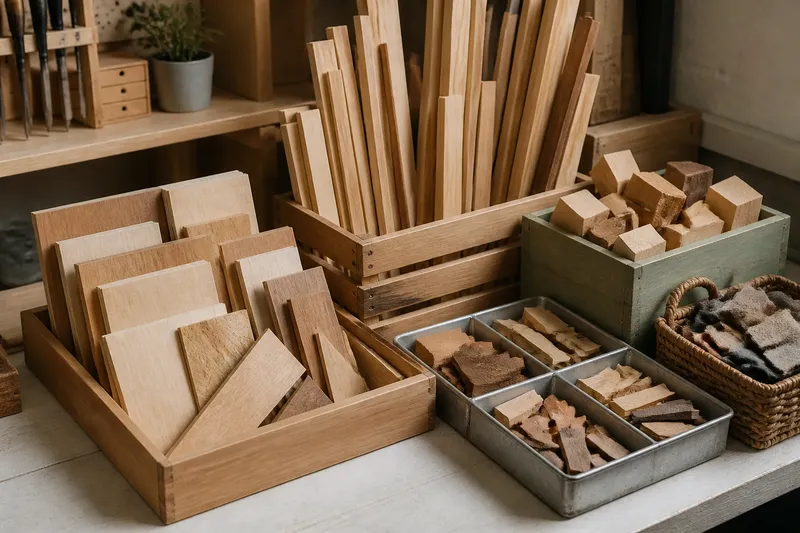
A shoebox of timber offcuts can become a jumble of splinters and near-matches before you find the piece you need. Sorting reusable offcuts by shape gives your eye a quick way in: long strips together, flat panels in a tray, wedges in their own container. The pieces need no polished names to be findable.
Labels still help when they record something you cannot see, such as a known material or source. But “useful bits” says little, and a precise description can take longer to write than the scrap is likely to save. Shape is a quick first filter. The aim is not a perfect inventory; it is a store where someone can look, compare and choose sensibly.
Labels and overlap
A drawer can fill with categories that sound tidy but overlap: “wood”, “craft”, “small” and “maybe useful”. The problem often starts with trying to predict every future use. One offcut might suit a plant marker, a packing shim or a small repair, so its imagined purpose keeps changing.
Group pieces by what is plainly visible instead. Put long, narrow strips in a rack, flat pieces in a shallow tray and short blocks in a sturdy box. Keep odd shapes in a separate, modest-sized container rather than forcing them into a group they do not fit. A person looking for a flat spacer can scan the panel tray without guessing what a previous sorter had in mind.
Begin with a few broad groups. Split one only when people repeatedly search through it for a particular form.
Containers that reveal
A heap can look like one category from above while hiding quite different shapes underneath. A stack of thin board may conceal a useful triangle, and fabric strips can knot into a single mass. The container may encourage piling rather than browsing.
Change the container before adding labels. A shallow tray lets flat offcuts lie in view; a narrow crate can hold long pieces upright; a divided tin keeps small, rigid shapes apart. For fabric, a loose fold or open basket may be easier to inspect than a tightly packed bag. Keep containers stable and suited to their contents, and do not leave sharp edges exposed to hands reaching in.
Make the likely choice visible from the top or front, not buried at the bottom.
Shape and material
Shape cannot answer every question. Two pieces may share an outline but differ in thickness, flexibility, finish or material. One smooth-looking offcut might be coated while another is untreated. If people cannot tell those differences apart, they may avoid the whole group or choose something unsuitable.
Keep shape as the main arrangement, then add a small amount of secondary information where it changes a decision. A divider can separate thick from thin, rigid from flexible, or known material from uncertain material. Use a visible note for a feature that cannot be seen at a glance, such as “painted” or “fabric blend unknown”. Do not give a confident material name when nobody knows it.
For shared stores, follow any material label, maker’s instructions or local rules that apply. If a material or intended use raises a safety concern, leave it out of casual reuse rather than expecting a label to settle the question.
Sorting questions?
Should every offcut get a label?
No. Label the container first with an ordinary description of the group, such as “long strips” or “flat panels”. Add a note to an individual piece only when it carries information someone could not reliably see.
What if a piece fits two groups?
Choose the group that makes it easiest to find, not the one that sounds most exact. If it is a flat triangle, keep it with flat pieces and leave its outline visible.
How should tiny scraps be sorted?
Use a small tray or compartment for scraps that share a useful form, such as short wedges or narrow tabs. If they are too varied to scan and have no clear use, do not let them crowd out pieces that can be selected quickly.
What belongs in an uncertain-material group?
Keep only pieces that are safe to store and whose uncertainty matters to a future user. Separate them clearly from known materials, and state what is unknown rather than guessing from appearance.
Room for new scraps
A sorting system can work at first, then quietly collapse as people add pieces wherever there is space. The containers may not suit their contents. If long strips are wedged into a shallow box, they bend, obscure one another and spill into neighbouring groups.
Give each shape group a clear home and leave enough room to see what is there. When a container becomes awkward to browse, split the group by a visible feature or remove pieces that are damaged, contaminated or plainly unusable. Do not add finer distinctions just to preserve every scrap. A useful store has room to be inspected.
Imagine a neighbourhood workshop with a deep tray of mixed plywood offcuts: broad panels, narrow strips and one splintered panel with a damaged edge. A member needs a small flat shim. They move the broad panels into a shallow rack, put the long strips upright in a separate crate and set the damaged panel aside for disposal under the workshop’s usual rules. The next person can compare the visible flat pieces without first lifting a heap of strips. The trade-off is a little rearranging now for easier browsing later; no label can make an unsuitable piece fit for use.
A system others understand
A tidy arrangement is not helpful if only its creator can interpret it. Cryptic marks, personal shorthand and elaborate categories make a shared shelf feel private. Use plain words that describe what a newcomer can see, and place each label where it can be read while browsing.
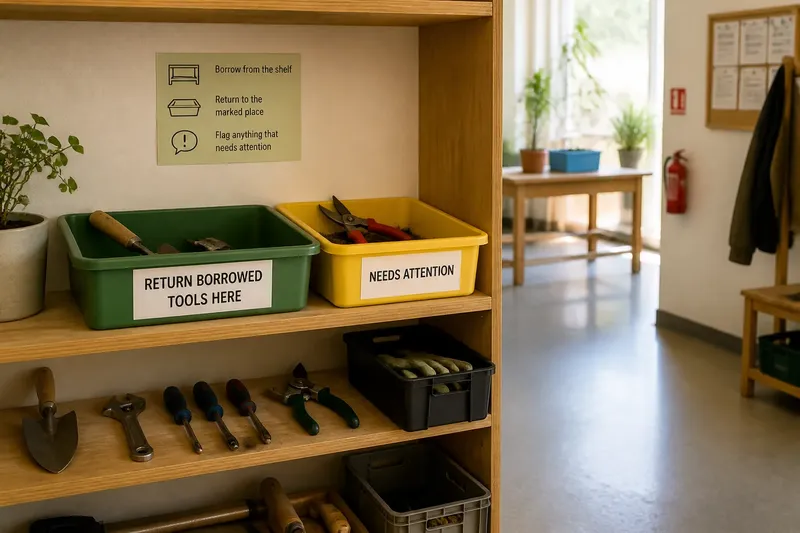
Make the arrangement easy to restore after someone takes a piece. A photograph of the empty containers can show where groups belong, while a simple sign can name them. If people keep returning pieces to the wrong place, treat that as feedback: the group may be unclear, the container may not suit the shape, or the label may be hidden.
For a shared stash, let visible pieces explain the system. One long strip standing in its crate can show the category more clearly than a paragraph of rules.
Choose for the next hand
Sorting by shape does not mean ignoring condition, material or a piece’s possible limits. It means using the clearest visible clue to help someone begin, then showing any extra detail that affects their choice. That balance keeps browsing simple without pretending every scrap is interchangeable.
When you sort reusable offcuts by shape, make the first decision clear at a glance: what form is here, where does it belong, and what should someone notice before taking it? A store that answers those questions plainly can remain useful even when nobody remembers who saved each piece.