Fit a Borrowing Stop into Your Saturday Errand Loop
Plan a borrowing stop on your Saturday errand loop to collect useful items without turning a local library or lending shelf into a separate trip.

Your shopping bag is already by the door, and the library book you meant to return is sitting on the hall table. A borrowing stop can fit into your Saturday errand loop if you connect it to a route you already make, rather than building a new outing around it.
The useful trick is to plan around the shape of the day: where you are going, what you can carry, and when the borrowing point is open. That keeps a library, lending shelf or neighbourhood tool cupboard in the orbit of ordinary errands without letting it dictate the whole route.
What counts as a borrowing stop?
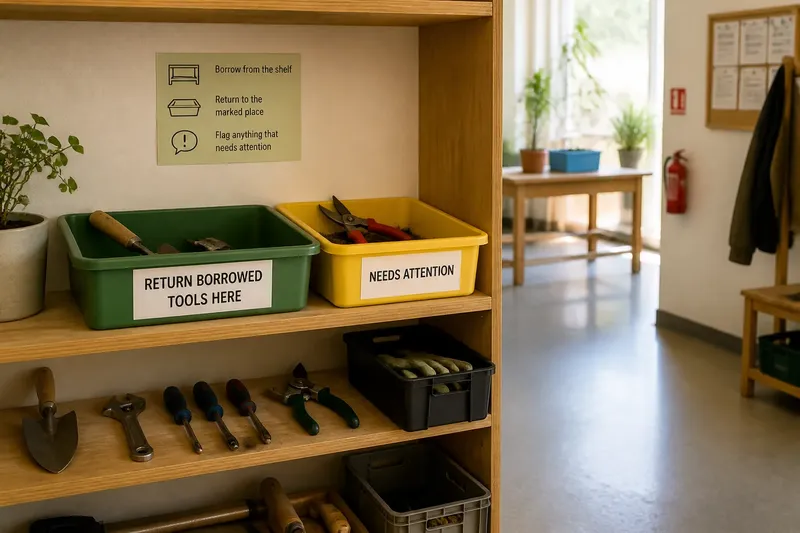
A borrowing stop is any place where you can collect or return something for temporary use: a public library, a community tool library, a lending shelf in a shared building, or a local group that lends equipment. The point is not to visit every kind of resource. It is to make one useful stop part of a journey you already need to take.
Start with the item you need and the place that actually lends it. A library may have books, board games or equipment; a tool library may lend a drill or garden tools; a shelf might offer only a small, changing selection. Check what is available before you plan around it, especially if the item is central to your task.
Keep the stop specific. “See what’s around” can turn into an aimless detour, while “collect a jigsaw for Sunday” gives you a clear reason to go and a simple way to judge whether the stop is worthwhile.
How do I choose the route?
Choose the errand that already anchors your Saturday, then look for a borrowing point near its path. A supermarket, post office, market, bus stop or visit to a nearby relative can serve as the anchor. Compare the route on foot, by bike or by public transport, rather than assuming a map’s shortest line is the easiest one.
Think about the sequence as well as the distance. A stop before a food shop may be awkward if you will be carrying a bulky item; a stop afterwards may work better if the library is open later. A lending shelf inside a community centre might be convenient on the way to the market, but not if its entrance is on the opposite side of a building you would otherwise pass.
Say you already walk to the Saturday market and want a hand tool for a small garden job. Imagine the local tool library is near the market but closes before you finish shopping. You could collect the tool first, carry it in a sturdy tote, then buy only what fits alongside it; the expected result is one joined-up outing, with the tool in hand before the lending point closes. If carrying it through the market sounds cumbersome, choose a different anchor errand or another borrowing point.
Plot the stops in the order you will actually travel, including the return journey. A route that looks tidy on a screen can feel less practical if it involves doubling back along a busy road or carrying an awkward item uphill.
What should I check before setting off?
Check opening hours, access arrangements and the borrowing rules before you leave. Some places require membership, a booking or a conversation with a volunteer; others use a simple sign-out system. Where the correct answer depends on the lending point’s rules or the maker’s instructions, follow those directions rather than guessing.
- Confirm the borrowing point is open during the part of your route when you can reach it.
- Check whether the item is available, reservable or likely to be in high demand.
- Find out what identification, membership details or booking information you need.
- Check the loan period and the return method, including any staffed hours.
- Consider the item’s size, weight and shape before choosing a bag or travel mode.
- Look at the weather and the route between stops if the item needs to stay dry.
- Keep a note of the return date and the next errand that could bring you back.
These checks are not a separate planning project. A quick look at the borrowing point’s noticeboard or online listing can prevent a wasted stop and help you decide whether the item suits the day you have in mind.
How can I fit the item around errands?
Match the item to the rest of the route. A paperback or small kitchen tool can slip into an ordinary bag. A long-handled garden tool, a sewing machine or a box of children’s games may need a direct walk home, a bike pannier or a car journey. Do not plan around a carrying method you do not have.
Consider the errands that could damage, soil or obstruct what you borrow. Put food shopping after a library stop if you want to keep books clean and dry. If you are collecting plants or loose materials from another local stop, separate them from borrowed items with a tote or cloth bag. For a bulky object, avoid stacking groceries against it or leaving it unattended while you make another stop.
Some errands are flexible and some are not. A parcel collection with a closing time may need to come before a leisurely browse; a market stall may be easiest to visit early. Put the time-sensitive stop first, then place the borrowing point where its hours and your carrying capacity allow.
Build a small amount of slack into the route. A queue, a closed side entrance or a conversation about how an item works can take longer than expected. If the day becomes crowded, skip the optional errand rather than rushing the borrowing handover.
What if the item is unavailable?
Keep a useful fallback that does not create another dedicated journey. You might choose a similar item from the same lending point, ask whether a reservation is possible, or move the borrowing stop to the next time you pass that way. If none of those options fits, carry on with the original errands and revisit the need later.
It helps to distinguish the task from the object. If you need to make a hole for a shelf, the task matters more than borrowing one particular drill; a different suitable tool, a local repair group or postponing the job may be reasonable alternatives. For a book, film or game, a different title can serve the same afternoon. The fallback should be practical, not a reason to take home something you will not use.
For a stop that often depends on volunteer availability or a changing shelf, check ahead if possible. If there is no reliable way to confirm stock, treat the visit as a pleasant possibility alongside the main errand, not the hinge on which the whole day turns.
How do I keep the return in view?
Pair the return with an errand that is likely to happen before the due date. If you borrow a book on the way to the grocer, returning it on a later grocery run creates a natural loop. A tool borrowed for a specific job can go back when you next visit the community centre, provided that timing fits the loan rules.
Make the reminder visible where it belongs: a note beside your keys, a calendar alert, or the lending point’s own reminder system. Keep any parts or accessories together with the item, and check that you know how returns work before you leave. A return that needs a staffed handover calls for a different plan from one accepted through a drop box.
Think of the borrowing stop as a small link in a route, not a destination that must dominate your Saturday. The best route is the one that fits your real errands, your way of travelling and the item you can comfortably carry. For a borrowing stop on your Saturday errand loop, attach the return to another familiar journey as soon as you borrow; that simple pairing makes the whole arrangement easier to remember.